
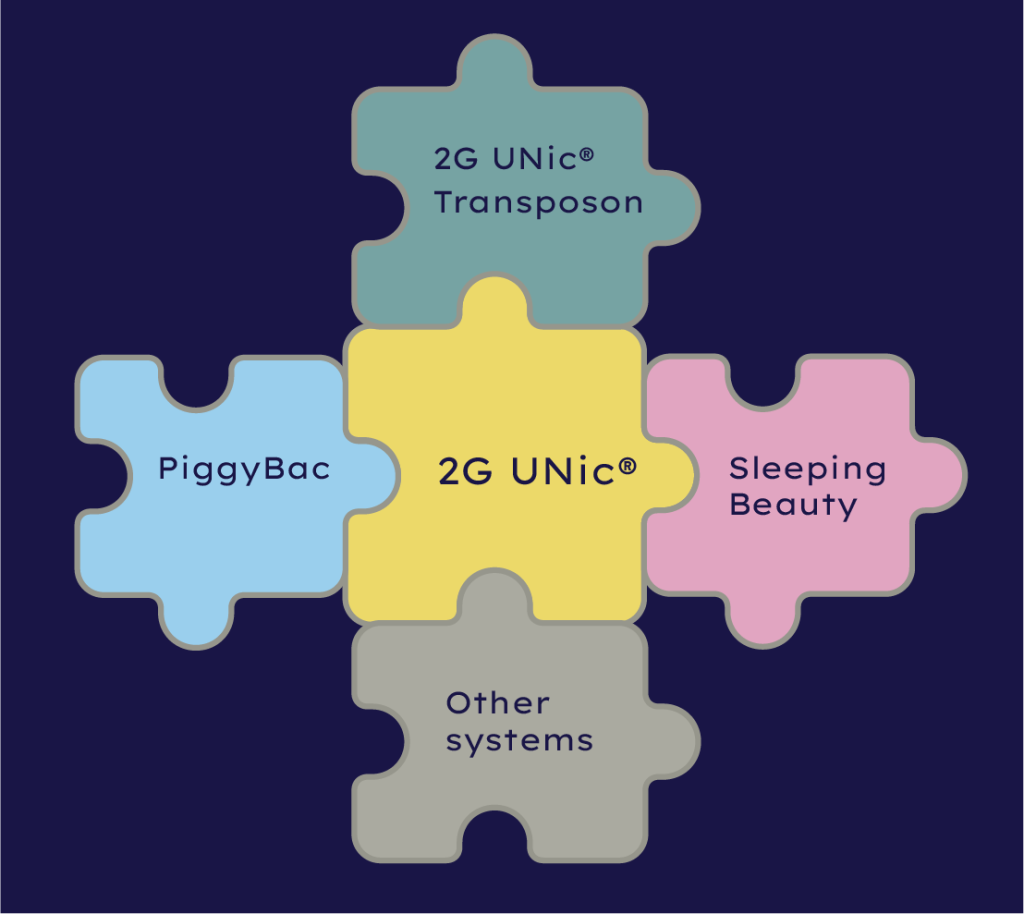
2G UNic improves protein expression, stability, and development timelines across CHO, HEK and microbial systems, without changing your workflow.
2G UNic is designed to increase protein yield and improve expression stability across CHO and HEK systems.
Across multiple programs, the platform delivers higher titers and more stable clones, accelerating progression from transfection to production.
This makes it valuable across both standard monoclonal antibodies and biosimilars, as well as complex or difficult-to-express molecules.
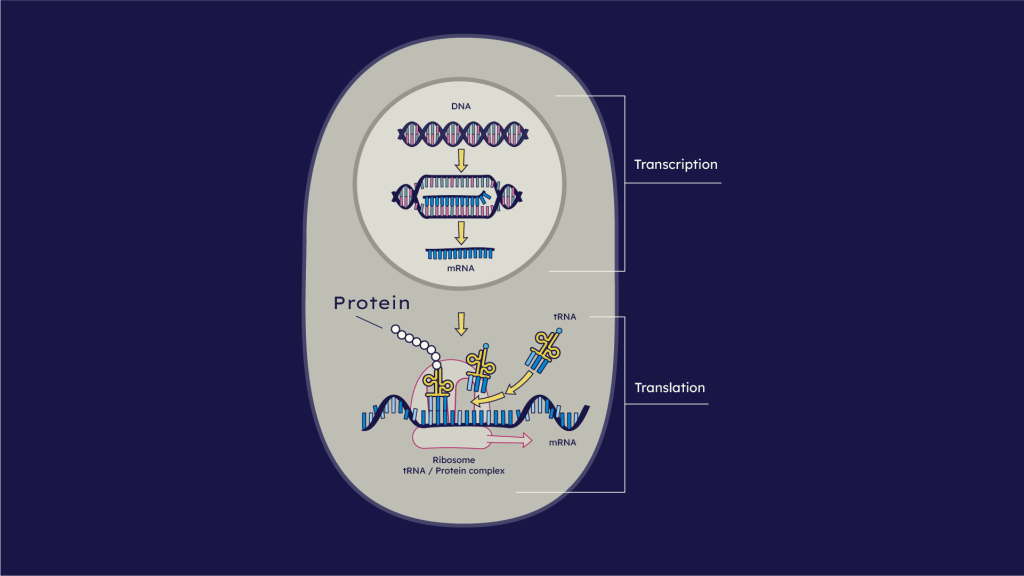
Optimizing every step of gene expression
2G UNic enhances protein production by improving each stage of gene expression:
1. Epigenetic regulation
Prevents gene silencing and maintains an open chromatin state for consistent transcription.
2. Transcription
A dual-promoter architecture drives strong, sustained mRNA production.
3. mRNA design
Optimized 5′ UTR and regulatory elements improve mRNA stability and intracellular transport.
4. Translation
Engineered elements enhance ribosome recruitment and increase protein synthesis.
Together, these features drive stronger and more stable expression across cell populations.
2G UNic is designed to increase productivity at both transcriptional and translational levels.
This results in:
By improving efficiency at each stage, the platform increases total protein output without increasing gene copy number or process complexity.
Versatility across mammalian and microbial hosts
2G UNic supports expression across multiple host systems.
In addition to CHO and HEK, it has been successfully implemented in yeast (Pichia pastoris / Komagataella phaffii) for production of recombinant proteins, enzymes, and vaccine antigens.
The same expression-enhancing principles apply across both mammalian and microbial systems.
Across multiple studies, 2G UNic delivers 2-6x higher titers compared to standard expression vectors in CHO and HEK-based systems.
In CHO antibody production runs, 2G UNic delivers 2-6× higher titers compared to standard expression vectors.
These gains are driven by improved transcription and expression stability, resulting in stronger and more consistent clone performance.
Crucially, performance improvements are achieved without changes to existing processes, allowing immediate integration into established workflows.
No Data Found
Across multiple studies, 2G UNic delivers 2-6x higher titers compared to standard expression vectors in CHO and HEK-based systems.
No Data Found
No Data Found
In CHO antibody production runs, 2G UNic delivers 2-6× higher titers compared to standard expression vectors.
These gains are driven by improved transcription and expression stability, resulting in stronger and more consistent clone performance.
Crucially, performance improvements are achieved without changes to existing processes, allowing immediate integration into established workflows.
2G UNic delivers improved productivity across major CHO host systems and selection platforms, including antibiotic, DHFR, and GS-based systems.
Host system compatibility:
Molecule format flexibility:
This consistency enables reliable performance across diverse development programs and production platforms.
No Data Found
In addition to strong performance in standard antibody and biosimilar programs, 2G UNic maintains strong expression performance even for challenging formats, including bispecific and multi-specific antibodies.
In published work (Peltret et al., Journal of Biotechnology, 2024), cell lines achieved fed-batch titers exceeding 10 g/L for a multi-specific antibody.
This highlights the platform’s ability to maintain high productivity in cases where expression is typically limiting.
Reference: Peltret et al., 2024. *Journal of Biotechnology* 389: 30–42. Development of a 10 g/L process for a difficult-to-express multispecific antibody format.
No Data Found

Consistent yield improvements across CHO-K1, CHO-S, CHO DG-44, and GS-based systems.
Performance maintained across IgG, Fc-fusion, and bispecific constructs
Improves productivity within existing workflows
We use cookies to improve your experience on our site. By using our site, you consent to cookies.
Manage your cookie preferences below:
Essential cookies enable basic functions and are necessary for the proper function of the website.
These cookies are needed for adding comments on this website.